The dominant claim in nursery decor writing is that hanging an alphabet poster above a crib helps a child learn letters. The claim is repeated by paint companies, by furniture retailers, and by roughly every 'nursery essentials' listicle indexed since 2015. As a studio that has drawn three alphabet charts — one in English, one in Español, one in Português, every letter paired with a friendly word in soft pastels — we think that framing is largely wrong. Children learn letters from being read to, from adults pointing at print in books and street signs. The chart on the wall is doing something else, and the something else is worth naming.
Why This Is Actually True
Before we take the framing apart, let us grant the parts of it that hold up. There is a legitimate reason the alphabet-poster-as-teacher claim has survived twenty years of nursery blogging. Some of it is right.
Print in the environment matters. A child raised in a room with visible letters treats letters as ordinary objects rather than as strange symbols that appear only during a lesson. The abecedario above the changing table becomes background scenery, the way a family calendar or a fridge magnet becomes scenery. When the child later encounters a K in a book, the K is not an alien. It has been on the wall the whole time. That familiarity is real, and it is not nothing.
There is also the pointing effect. A parent standing at the crib rail, waiting for the child to settle, will read the wall out of sheer boredom. A is for apple. B is for bear. This happens hundreds of times across a nursery's life. The chart gives the adult something to do with a restless toddler, and in the doing, letters get named aloud. That naming is where letter learning actually happens — not from the poster, but from the adult using the poster as a script.
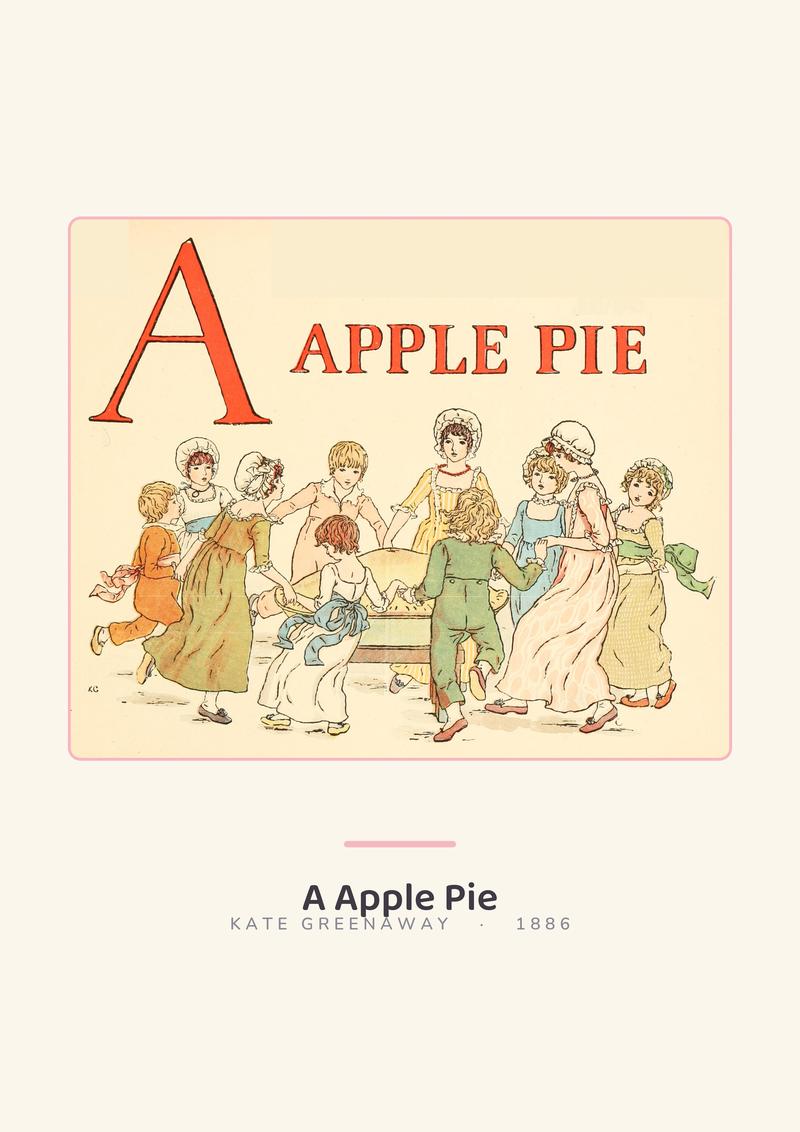
The visual design of a good alphabet chart also does honest work. A well-drawn A next to a friendly apple, in a pastel palette a small child can parse, teaches shape recognition in a way that undecorated flashcards do not. Children who see the letter A tied to a warm, memorable image build a hook. The hook is not sound-symbol correspondence — that comes later, from real reading instruction — but it is a pre-hook, and pre-hooks are useful.
So: environment matters, adult narration matters, and consistent friendly imagery gives the child something to attach to. None of this is controversial. If a nursery blog says an alphabet chart contributes to a literate environment, the blog is right.
The problem is what comes next.
But here is what that framing misses entirely: the poster on the wall is a design object doing design work, and pretending it is a literacy intervention lets everyone off the hook for the actual literacy work — which is a lap, a book, and an adult voice.
Where It Breaks Down
Once the claim escalates from "contributes to a literate environment" to "helps children learn the alphabet," the whole thing collapses. And it always escalates. The retailer copy says "educational." The blog headline says "boost early literacy." The Pinterest caption says "helps toddlers learn their ABCs." None of that is defensible.
Consider the actual mechanics. An alphabet chart hung above a changing table is roughly one meter from the child's eye at chest-carry height, and roughly two meters when the child is lying down. From two meters, a poster printed at typical A2 or 50×70 cm size shows letters that are perhaps eight to ten centimeters tall — legible, but the child on the changing pad is looking at the ceiling, at the mobile, or at the adult's face. Not at the wall behind the adult's back. The physical geometry of a changing-table setup means the chart is mostly visible to the adult, not to the child being changed.
Now consider a chart hung in a play area at toddler eye level. The child can see it, yes. But a fifteen-month-old is not scanning a chart from left to right and internalizing letter shapes. A three-year-old might sit and point at letters, but only if an adult is sitting alongside naming them. The chart alone, with no adult and no prompt, teaches roughly zero letters. This is not a controversial claim among reading researchers. It has been the mainstream view since the 1980s. Marilyn Jager Adams wrote the book on it. Nothing about a poster overrides the fact that letter knowledge comes from adult-mediated exposure — being read to, being sung the alphabet song, being asked "what letter does your name start with" during a car ride.
The retailer framing also flattens the three genuinely different jobs a chart can do. Our El Abecedario in Español, our O Alfabeto in Português, and our The Alphabet in English are not interchangeable literacy tools. They are three different design objects with three different purposes in a household. In a bilingual home, the second-language chart is a claim about identity — this language belongs on this wall, in this child's room, at eye level with the first-language books. That claim is worth making. But it is not a literacy intervention. Calling it one degrades the actual claim, which is a design and identity claim.
And there is the harm buried in the escalated version. When a parent buys a poster believing it will teach letters, and the child at four still cannot name most of the alphabet, the parent blames the child, or blames themselves, or blames the school. What actually failed was the marketing claim. The poster did what posters do. Nobody read aloud enough.
The Rule I Use Instead
We draw alphabet charts. We sell them. We think they belong on nursery walls. And we think the honest reason for hanging one is not literacy but three concrete design and household jobs that a chart does well and that nothing else does as economically.
The first job is anchoring a wall. A nursery has vertical surfaces that need something on them, and the choice is between nothing, a licensed cartoon character, a random landscape print, or a chart with content the child will grow into. A chart wins because it stays interesting across the age range the room needs to serve — a nine-month-old looks at the color blocks, a two-year-old points at the pictures, a five-year-old reads the words, a seven-year-old ignores it entirely but does not find it babyish enough to demand its removal. Very few nursery objects survive from month nine to year seven. A well-drawn alphabet chart does.
The second job is giving the reading adult a prompt. A parent holding a fussy baby at 5 a.m. does not need a literacy intervention. They need something to talk about that does not require thinking. The chart is a script. A is for apple, said out loud for the hundredth time at dawn, is not teaching the letter A. It is giving the exhausted adult a way to make sound in the child's direction while holding still. That is a real and valuable job, and it is not the same job the marketing copy claims.
The third job — the one that most justifies buying the chart in the language the child does not yet speak — is putting a second alphabet on the wall as a durable, low-pressure signal that this language exists in the home. A Portuguese-heritage child in Ohio, an English-heritage child in Barcelona, a Brazilian-Spanish bilingual household anywhere: the second chart is not there to teach reading in the second language. It is there so the child does not grow up thinking their heritage language is a Skype-call thing, or a grandparent thing, but a thing that lives on their wall the same way the first language does.
The rule, then: hang the chart because it is a good design object doing a real design job, not because a blog told you it would produce literacy outcomes. Judge the chart on drawing quality, palette, letter clarity, and durability of appeal. Judge the literacy outcomes on how much you read aloud.
When the Old Rule Still Wins
We should concede where the conventional framing is still the more useful lie. In two situations, treating the alphabet chart as an educational purchase is doing net good even though the underlying claim is soft.
The first is when the framing is what gets the chart onto the wall at all. If a parent is on the fence between spending forty pounds on a chart or nothing, and the "educational" label tips them toward the chart, the child ends up in a room with a chart, which is better than a room without one. The environmental exposure argument still applies. The marketing overpromise ends up producing a mild real benefit by accident. Fine. We will not fight that fight.
The second is when the chart is part of a household where an adult actually does treat it as a teaching tool — sits with the child, points, names, asks. In those homes, the chart is doing something close to what the copy claims, because the adult is doing the work. The chart is the prop. Underneath the marketing overreach, there is a version of it that comes true when the adult shows up. That version deserves the credit the marketing tries to steal for the chart itself.
FAQ
What size alphabet poster works best for a nursery wall?
For most nursery walls, a chart around A2 (42×59 cm) or 50×70 cm sits well above a changing table or above a low bookshelf. Larger than 70×100 cm starts to dominate and loses the intimate, at-eye-level quality that suits a small child's sightline once they are walking. Smaller than A3 becomes decorative filler rather than an object the child can approach and point at. Reading distance for a toddler standing near the wall is roughly one meter, which is what our letter sizing assumes.
At what age does an alphabet chart become useful to a child?
There is no threshold. A newborn sees color and contrast, so a pastel chart is visual food from month one. A one-year-old will point at pictures. A three-year-old will begin naming letters if adults have been naming them aloud. A five-year-old will read the paired words. The chart is not doing different work at each age — the child is doing different work with it. The chart's job is to still be there, quietly, across all of those ages without becoming babyish or falling apart.
Should we hang an alphabet chart in a language the child does not speak yet?
Yes, when the second language belongs in the household — a heritage language, a grandparent's language, the language of a place the family plans to live. The chart is not there to teach the language on its own. It is there so the language has a visible, non-negotiable presence in the child's room, at the same status as the first language. Our El Abecedario and O Alfabeto exist for exactly this. The chart is a signal, not a curriculum.
Where in the nursery should the alphabet poster hang?
Not directly above the crib, where the child cannot see it from inside and the adult risks knocking a frame onto a sleeping baby. Above a changing table, above a low bookshelf, or on a play-area wall at adult-standing eye level, so an adult holding the child can point at letters. Once the child is walking, dropping a second chart to their eye level in a play corner adds a surface they can approach on their own. Height matters less than the presence of an adult nearby who will read it aloud.
Do children actually learn letters from wall charts?
Not from the chart alone. The evidence on early literacy is clear that letter knowledge comes from adult-mediated exposure — being read to, being asked questions about print, hearing the alphabet song, having someone point at street signs. A chart with no adult narration teaches close to nothing. A chart with adults who use it as a prompt for daily naming contributes to the ambient print environment that supports later reading. The chart's contribution is real but small, and it is downstream of adults reading aloud.
Is a plain alphabet chart better than one with pictures?
For a nursery, pictures earn their place. A young child cannot yet decode letters, so pairing each letter with a friendly, memorable image gives the child something to attach to before the letters carry meaning. The picture also gives the reading adult something to talk about beyond the letter itself. Plain letter-only charts work better for older classroom use, once the child is decoding and the pictures become clutter. In a room for ages zero to five, the paired-word format does more work.
How long will an alphabet poster stay relevant in a child's room?
A well-drawn one lasts from the newborn stage through roughly age seven, which is longer than almost anything else in a nursery. Cot sheets get outgrown in a year. Mobiles get put away by eighteen months. Themed decor tied to a specific character has a two-year window before it feels stale. A chart in a restrained palette, with clear letters and non-licensed imagery, keeps working because the content does not date and the drawing style does not tie it to a passing trend. That longevity is the real value proposition, not literacy.
Can we mix alphabet charts in different languages on the same wall?
Yes, and we would encourage it in bilingual or trilingual households. Hanging El Abecedario next to The Alphabet, or O Alfabeto alongside both, treats the languages as peers on the wall the way they are peers in the child's life. Design-wise, keep the charts in a compatible palette and matching frame treatment so the wall reads as one gallery rather than three competing objects. A shared soft-pastel palette across the three charts is what makes the combination work rather than clash.
From the collection
New nursery prints and 10% off your first order.
One email now with your code. No noise after.